Spinning your tires in thick clay, sliding off a rain-slicked shoulder into a drainage culvert, or bottoming out over a concrete parking curb will bring your day to a sudden halt. Pressing the gas pedal harder only digs the wheels deeper into the ground and puts extreme stress on your transmission and axles.
C F Towing Charlotte provides commercial-grade winch-out recoveries engineered to pull passenger cars, work vans, and heavy pickup trucks back onto solid ground without bending a single body panel. Equipped with hydraulic power winches, extended synthetic and steel tension lines, and specialized snatch blocks, our recovery operators extract trapped vehicles from tight spots and steep drops.
Whether your tires are just a few feet off the asphalt or your frame is resting on soft earth fifty feet down an embankment, we set up a controlled, calculated pull that gets your vehicle safely back onto the road.
Getting trapped along a dark highway curve or stuck in rising water during a storm is an urgent safety hazard. Our emergency winch out service operates 24 hours a day, 7 days a week, with rapid-response units ready to deploy the moment your call comes in.
When you contact our dispatch center, we immediately verify your safety and pinpoint your exact coordinates using smartphone GPS tracking. From there, we send a recovery truck with the exact line length and pulling capacity required for your situation.
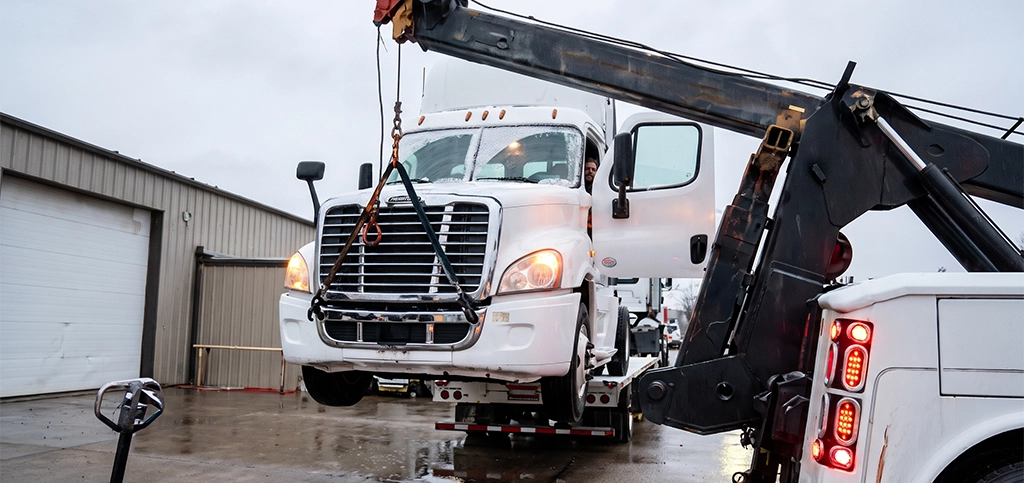
Upon arrival, our operator secures the scene with high-visibility traffic cones and directional strobe lights, rigs the extraction lines to your vehicle’s factory structural points, and performs a smooth, steady recovery so you are never stranded in harm’s way.
Every extraction presents different ground conditions, angles, and resistance levels. A successful stuck vehicle recovery requires matching the pulling technique to the specific terrain holding your tires in place.
Wet red clay, saturated grass, and soft dirt create a strong vacuum suction around your tires and undercarriage. Simply yanking a bogged car forward can rip off plastic splash guards or bend control arms. Our mud recovery towing services use controlled, low-speed hydraulic line tension combined with angled snatch-block rigging to break the mud’s suction gradually. Once the tires lift onto traction mats or solid turf, we guide the vehicle smoothly back onto dry pavement.
Sliding off the shoulder into a roadside trench or culvert leaves your vehicle tilted at a steep, unstable angle. Standard straight-line pulling can cause the vehicle to roll over or dig its front bumper directly into the dirt bank.
With our ditch recovery services, technicians use multi-point rigging and adjustable boom angles to lift and guide the chassis up the slope simultaneously. This prevents undercarriage scraping and keeps all four wheels stable until the vehicle is level on the highway shoulder.
Construction crews, delivery drivers, and outdoor enthusiasts frequently navigate unpaved access roads, gravel pits, sand, and wooded trails where hidden ruts can trap a frame instantly. Our off road vehicle recovery units carry up to 200 feet of high-tensile winch cable and portable anchor gear.
Even if our truck has to stay parked on firm ground far away from your location, our extended rigging reaches deep into unpaved work sites and trails to bring your rig out safely.
When a four-wheel-drive truck, lifted SUV, or loaded utility van gets stuck, it is usually buried deep in heavy terrain where standard equipment cannot reach. Executing a 4×4 vehicle recovery demands higher line-pull ratings and reinforced rigging hardware.
We deploy heavy-duty twin-line winches and double-line pulley setups that double our pulling force, allowing us to extract heavy frames buried up to the axles without straining your drivetrain.
Hooking a metal chain around an axle tube or tie-rod is a common mistake made by amateurs trying to pull a stuck car with a pickup truck. A professional tow truck winch out relies on purpose-built rigging hardware that distributes pulling force evenly across your vehicle’s strongest structural points.
Modern sedans, crossovers, and electric vehicles feature aerodynamic plastic bumpers, aluminum suspension parts, and unibody frames that bend easily under raw metal hooks. During a car winch out service, our technicians use heavy-duty nylon bridal straps, soft shackles, and screw-in factory tow-eye adapters.
These synthetic straps cushion the contact points and route the pulling line below the front valence or rear diffuser, ensuring painted surfaces and suspension geometry stay completely untouched.
Heavy rainstorms, flash flooding, ice patches, and sudden swerves to avoid road debris often push drivers onto soft highway medians or over raised concrete islands. Our roadside winching services are built for fast execution along busy interstates and city streets.
Using hydraulic outrigger stabilizers that anchor our truck firmly into the asphalt, we can pull vehicles sideways or backward out of median traps without blocking extra lanes of moving traffic for long periods.
Choosing C F Towing Charlotte for your vehicle winch out service means getting certified recovery specialists, commercial equipment, and transparent pricing from start to finish:
When you contact a local winch out service near me, a dispatched recovery unit typically arrives at your location within 30 to 45 minutes. Calls involving vehicles tilted near water, blocking active traffic lanes, or stranded in severe weather receive immediate priority dispatch.
Yes. Professional operators never attach hooks to steering tie-rods, fragile suspension arms, or plastic bumpers. By using factory frame slots, threaded recovery eyes, and soft nylon endless loops paired with elevated boom angles, the vehicle is lifted and pulled clear of the ditch bank without scraping or bending any parts.
Not always. If your vehicle slid gently into mud, wet grass, or a shallow ditch and shows no fluid leaks, flat tires, or steering damage, you can drive away immediately after the winch-out is complete. If the vehicle suffered mechanical damage during the slide, the operator can load it onto the truck bed right away.
Let the dispatcher know your vehicle’s year, make, and model, how far off the paved road the vehicle is sitting, and what type of surface it is stuck in—such as deep mud, a steep ditch, or perched on a curb. Sharing whether the wheels are straight or buried helps us bring the exact cable extensions and rigging tools needed.