Turning the key on the fourth floor of a concrete parking structure or two levels below an apartment building—only to hear a dead click—creates an immediate problem. As soon as you look up at the yellow clearance bar hanging from the ceiling, you realize a normal roll-back flatbed or heavy wrecker cannot even enter the building.
Getting a broken-down vehicle out of a cramped structure takes specialized low-clearance towing designed specifically for low ceilings, sharp ramp corners, and narrow driving lanes.
Standard recovery trucks stand between eight and ten feet tall, meaning they would tear down overhead water pipes, security cameras, and concrete support beams before ever reaching your parking stall.
At C F Towing Charlotte, we operate custom-built extraction units that slip effortlessly under low entrance bars, navigate tight corkscrew turns, and bring your car safely out to street level without a single scrape.
Modern multi-story garages are engineered to pack as many cars as possible into a small footprint, leaving very little vertical or horizontal room for commercial vehicles. Many older downtown decks, hospital garages, and hotel basements have maximum height limits between six feet two inches and six feet eight inches.
Beyond the ceiling height, concrete pillars are spaced closely together, and exit ramps often feature steep grades paired with blind ninety-degree turns.
A purpose-built low clearance tow truck overcomes these physical barriers through three specific design adjustments. First, the cab and chassis sit on a lowered suspension profile with compact emergency lighting mounted flush against the roof, allowing the truck to clear overhead obstacles with inches to spare.
Second, the truck features a shorter wheelbase than a traditional highway wrecker. This compact length gives the driver a tight turning radius, making it possible to swing around narrow corners and back into cramped stalls between parked cars.
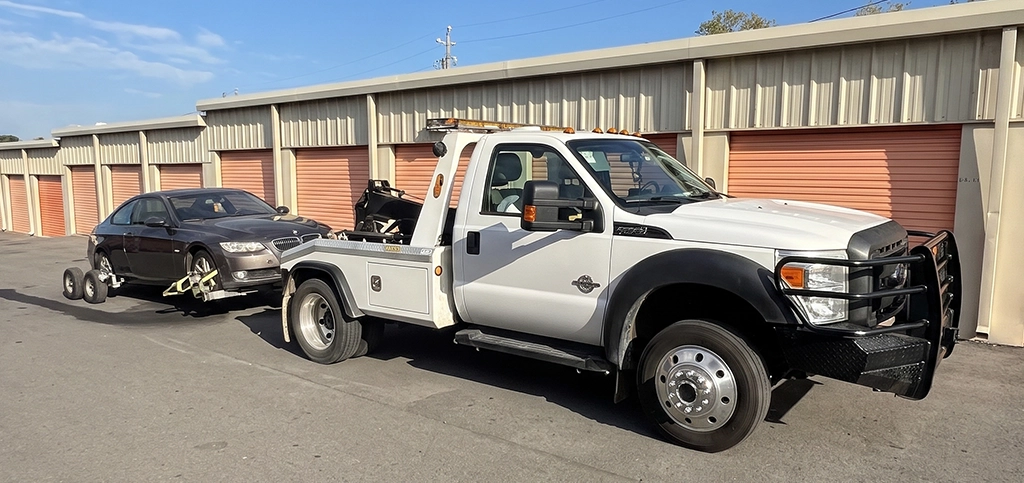
Finally, these trucks use a specialized hydraulic under-lift—often called a stinger or wheel-lift—that stays low to the floor. Instead of winching your vehicle up onto a high steel deck inside the garage, the hydraulic arm slides beneath your front or rear tires and cradles the rubber wheels just a few inches off the concrete.
This keeps the roof of your car well below low-hanging fire sprinklers, ventilation ducts, and lighting fixtures during the entire ride out of the building.
Every parking facility has its own layout and structural hazards. Whether your vehicle is stranded on the top level of an open-air commuter deck or tucked into the deepest corner of a private residential basement, choosing the right extraction method prevents costly body and mechanical damage.
Above-ground structures at shopping malls, airports, office parks, and medical centers rely on winding spiral ramps or narrow two-way lanes to move traffic between floors. When a vehicle stalls on an upper level—or breaks down right in the middle of an exit spiral—standard wreckers are completely locked out.
Professional parking garage towing uses nimble wheel-lift units that match the width and turning path of a regular pickup truck. Our operators carefully guide your vehicle down winding ramps while maintaining full braking control, ensuring the rear bumper never swings wide into concrete guardrails or neighboring parked cars.
Subterranean garages beneath high-rise condos, hotels, and corporate towers present an extra challenge: steep approach and departure angles. Where a flat basement floor meets a sharp upward ramp, a towed car can easily drag its nose or tail on the concrete if lifted at the wrong angle.
With underground parking garage towing, the operator adjusts the hydraulic tilt of the under-lift bar on the fly as the truck climbs the grade. This keeps your vehicle level with the slope of the ramp so the undercarriage, exhaust system, and bumpers clear the transition smoothly.
Parking decks are a common spot for luxury sedans, sports cars, custom lowered builds, and vehicles with air-ride suspensions that have lost pressure and dropped onto their wheel wells. When a car sits just a few inches off the floor, standard metal lifting grids can crush carbon-fiber front splitters or pinch side skirts.
Our low profile vehicle towing process uses low-angle wheel cradles, rubberized contact pads, and wooden or composite approach ramps to create extra clearance before lifting. By gripping only the tires, the painted bodywork and aerodynamic trim remain completely untouched.
Removing a car from a crowded parking bay is not always necessary if the underlying issue can be fixed right in the stall. Before hooking up your vehicle, our technician checks whether fast low clearance roadside assistance can get you driving again on your own.
Because cars in garages are often parked nose-first against a solid concrete wall, reaching the battery under the hood with standard jumper cables from another car is impossible. Our service trucks carry high-output portable lithium jump-packs and extra-long commercial booster cables that easily reach the front of your engine bay, even when your bumper is inches from a wall.
If you are dealing with a flat tire in a tight space, we use low-profile hydraulic floor jacks to swap on your spare safely. We also carry non-marring door unlocking tools for keys locked inside the cabin and can deliver fuel if your tank ran dry while looking for a parking spot.
Some breakdowns involve more than a dead battery. An electric vehicle may lock its electronic parking brake and refuse to shift out of park. A broken ball joint or tie-rod can leave a wheel turned sideways. A key fob failure can freeze the steering column while the car is wedged between two concrete pillars. Dragging the car forward in any of these cases would shred the tires and damage the transmission, so we recover it in steps.
When searching for low clearance towing near me, always check the yellow height limit sign at the garage entrance and share that exact measurement with the dispatcher. Look for a local provider with dedicated low-profile wheel-lift trucks and portable wheel dollies rather than a company that only operates standard tall flatbeds.
Most specialized parking deck towing services can safely enter structures with overhead clearances as low as six feet two inches to six feet four inches. If a basement ceiling is even lower, technicians can use portable winches and hydraulic wheel skates to roll the vehicle out to a higher staging area.
In most metro areas, emergency parking garage towing arrives within 30 to 45 minutes of your call. If your stalled car is blocking an active entrance gate, single-lane ticket booth, or exit ramp, dispatchers prioritize your call to clear the bottleneck quickly and safely.
When a steering wheel is locked, or a transmission is stuck in park, underground garage vehicle removal relies on hydraulic caster dollies placed beneath all four tires. These dollies allow the technician to pivot and roll the car out of its stall without forcing the steering rack or dragging the rubber across the concrete.
No. Because a low-profile wheel-lift raises the tires only a few inches off the ground and pivots automatically on steep ramps, your car stays near its natural driving height. Soft tire straps and rubber blocks ensure nothing scrapes your bumpers, exhaust, or roof.
Yes. For all-wheel-drive vehicles, electric cars, or long-distance trips, C F Towing Charlotte can extract your vehicle from the garage using a low-boy wheel-lift and dollies, then transfer it directly onto a standard flatbed truck waiting on the street outside.